Projects & evidence.
Explore the architecture, selected public code, real demonstrations and measured evidence behind my music and creative technology projects.
Xunpu Studio · analysis and feedback
Score input and structured musical evidence connect three reviewable modules: harmony, form and assignment feedback. Each returns candidate interpretations or issues for a musician to inspect and revise.
| Module | Workflow | Evidence scope |
|---|---|---|
| Harmony | Score → harmonic events → candidate labels → score annotations | Saved 10-measure, 24-event case; first 12 events have applicant-confirmed review. |
| Musical form | Measure-aware representation → boundaries → hierarchy / timeline | Research and product workflow; musical correctness still needs score review. |
| Assignment feedback | Score / rubric → candidate issues → numbered annotations | No public student data or grading-accuracy study is released. |
Xunpu AI Synth · 0.5 research build
Text-to-Timbre: a model proposes editable synthesis parameters, while a local native FAD engine produces the sound. The 0.5 local research build includes six synthesis pages, 16 voices, A/B comparison, WAV preview export and conversational patch refinement.
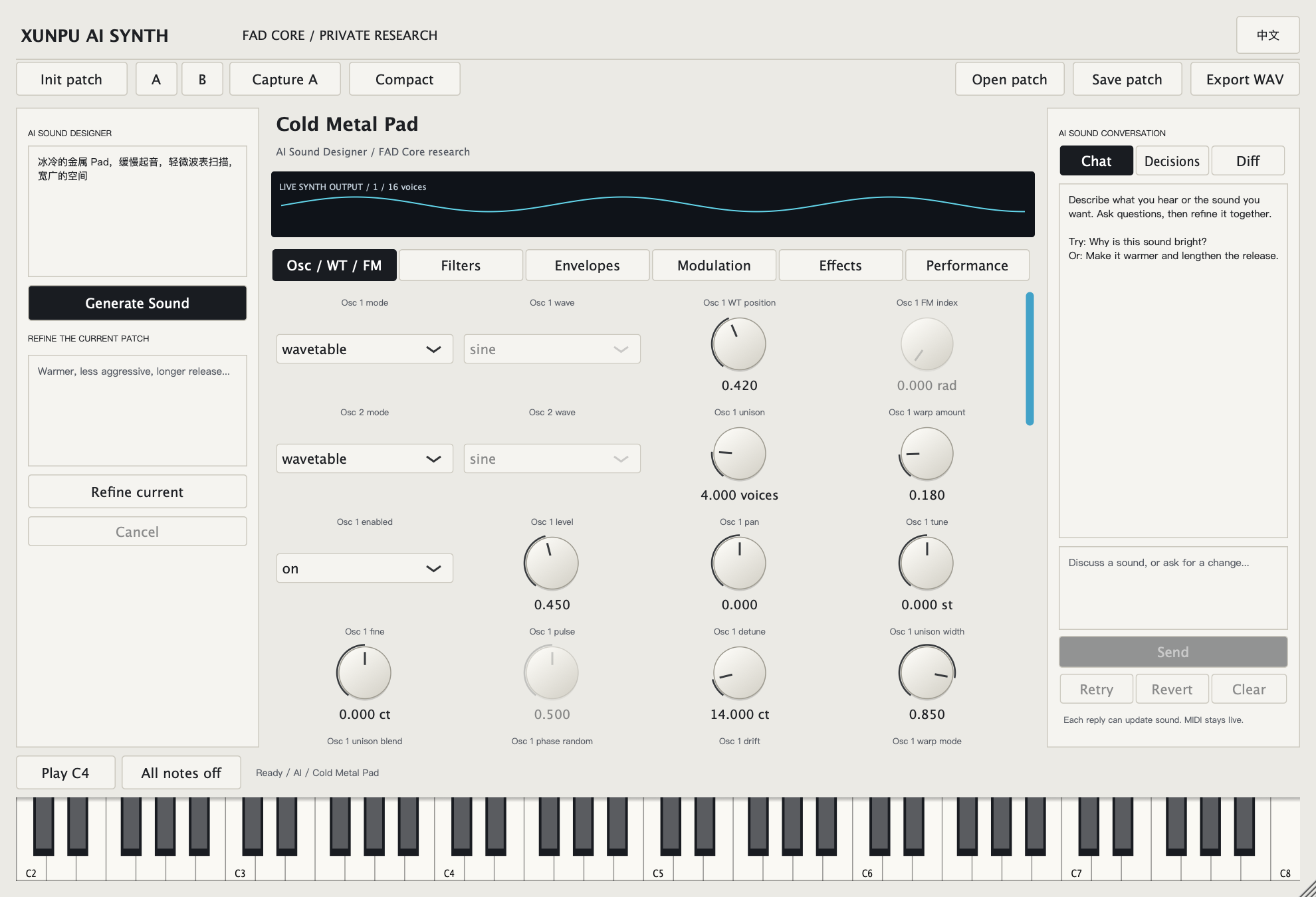
Xunpu AI Synth · v0.5 FAD research build · captured 25 October 2026. Select the image to enlarge.
Earlier v0.4 recordings & engineering evidence
The earlier 0.4 MVP exposed 90 host parameters. Selected engineering records include strict AU validation, a JUCE VST3 host harness, 17 parameter-sensitivity measurements and five real provider-designed families with finite nonzero local renders. A recorded one-field refinement changed cutoff from 1500 to 1800 Hz while the other 89 parameters stayed unchanged.
Recorded on Apple M4 / macOS 27.0.1, 21 October 2026. These previews use C4 at velocity 0.8, 2 seconds held and 8 seconds total, 48 kHz stereo PCM24. Signal distinction does not establish perceptual quality or arbitrary-prompt success. Named DAW sessions, physical MIDI and formal listening evaluation remain outstanding.
MGSA · preliminary research
Symbolic scores → measure representation → musicology-guided structural attention → boundary candidates. This pilot uses sonata-grouped splits from the DCML Mozart corpus, with projected phrase-ending targets.
| Model | Exact boundary F1 | ±1-bar boundary F1 |
|---|---|---|
| Mean-pooling Transformer | 0.3133 ± 0.0164 | 0.4324 ± 0.0109 |
| Learned pooling, no priors | 0.3297 ± 0.0135 | 0.4588 ± 0.0136 |
| MGSA | 0.3332 ± 0.0156 | 0.4569 ± 0.0317 |
Fold 0 · five seeds · five epochs. SD measures seed variation. Results do not establish consistent gains or significance; this is not the complete five-fold study. Global form and independently supervised relation metrics are unavailable.
Audio boundary review
Single-recording boundary example
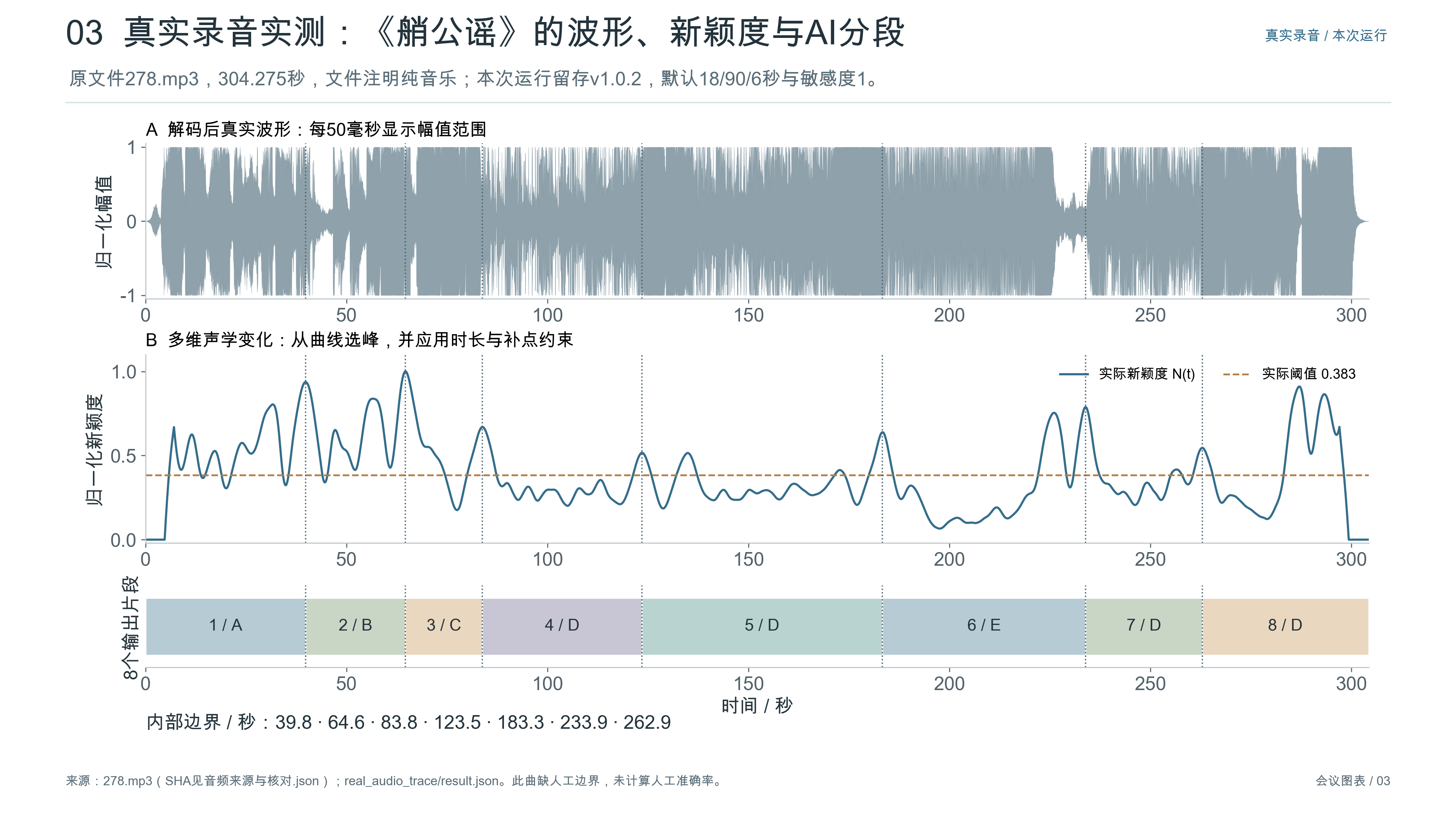
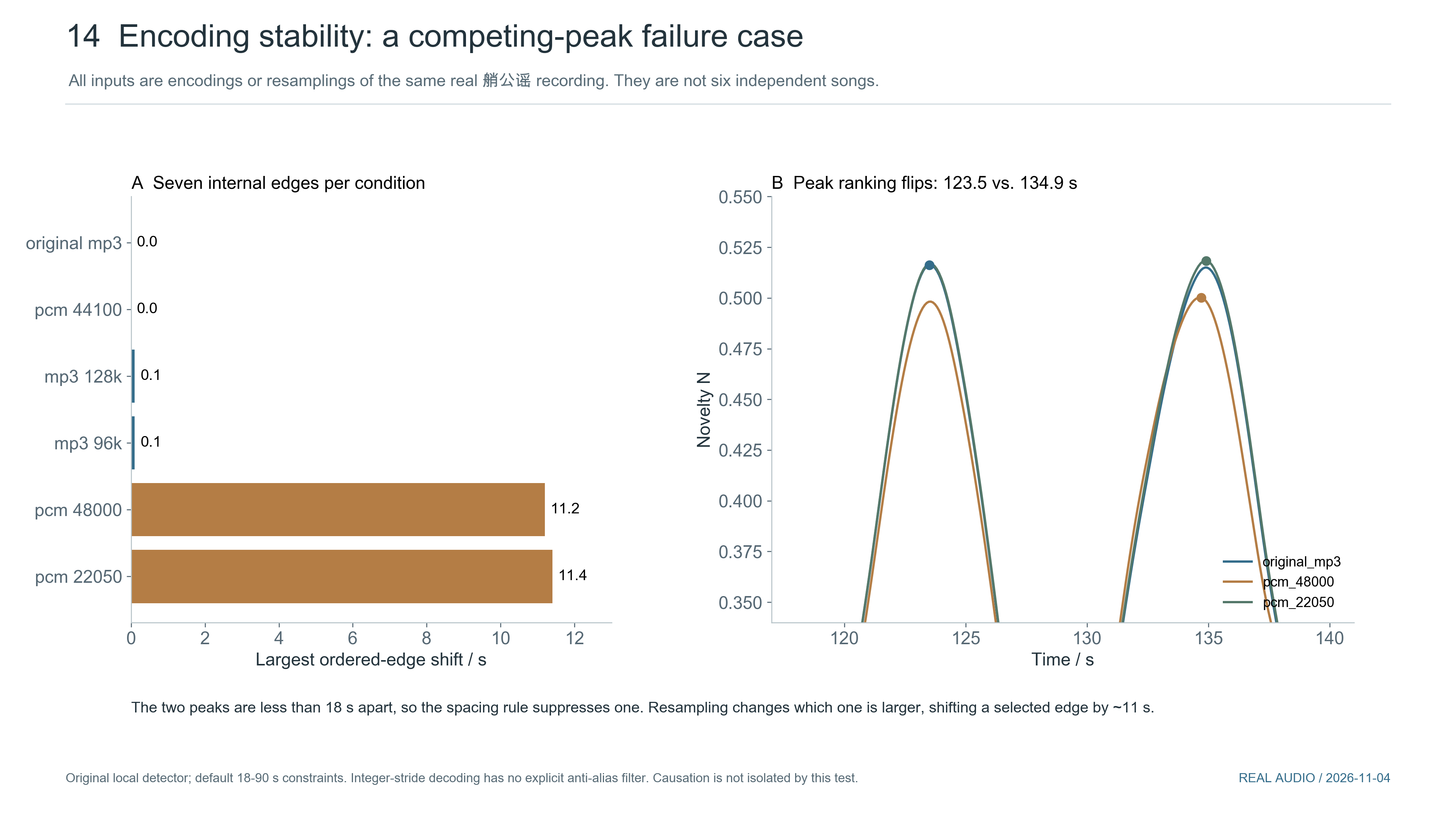
In this run, acoustic novelty peaks and duration constraints yielded candidate boundaries at 39.8, 64.6, 83.8, 123.5, 183.3, 233.9 and 262.9 seconds. This recording has no human reference boundaries.
Separate batch processing record
The recorded review batch covers 420 songs, 2,865 segments and 2,445 boundaries. Waveform-assisted processing changed 2,247 boundaries and left 198 unchanged; 301 lyric-match cues were recorded.
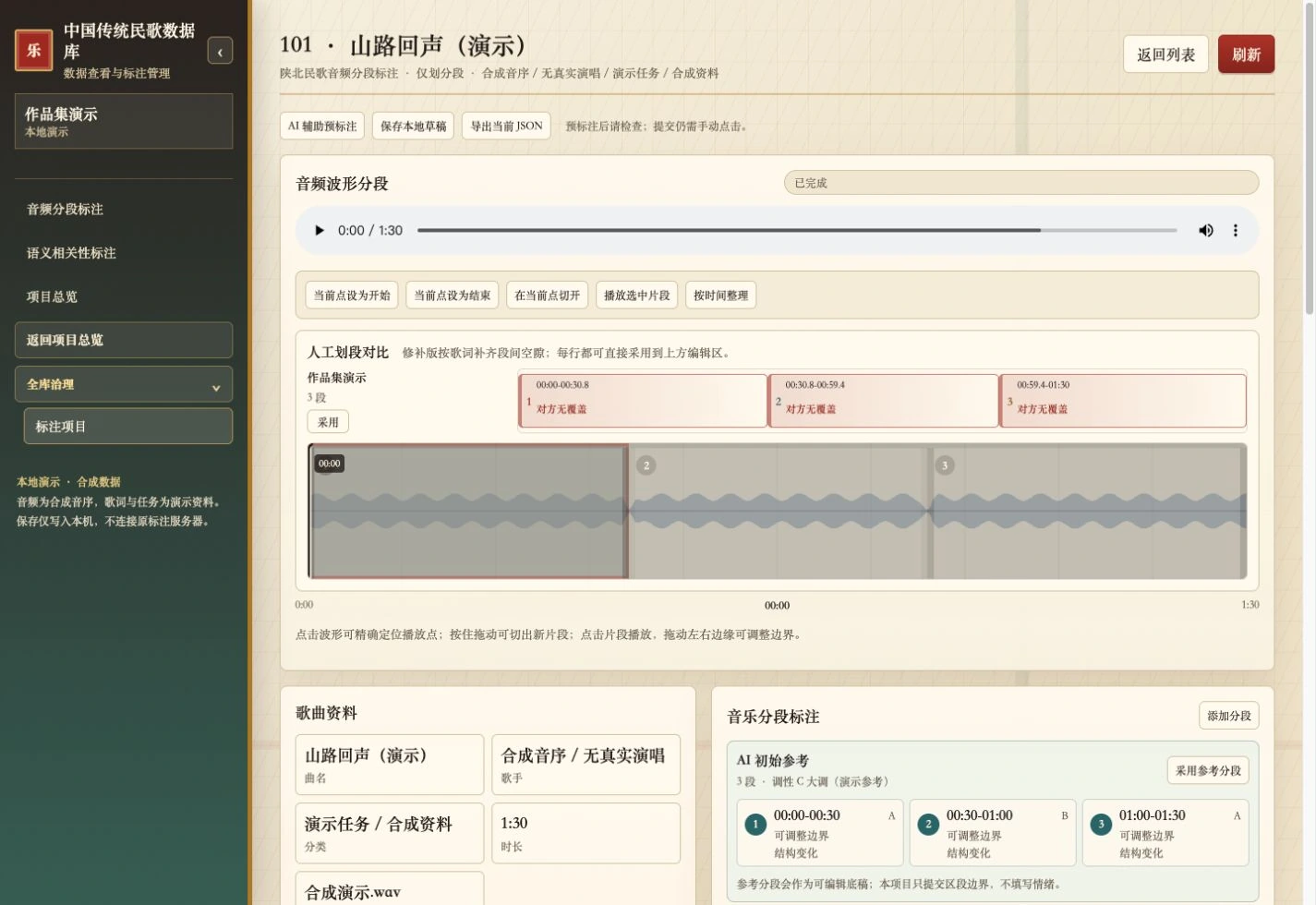
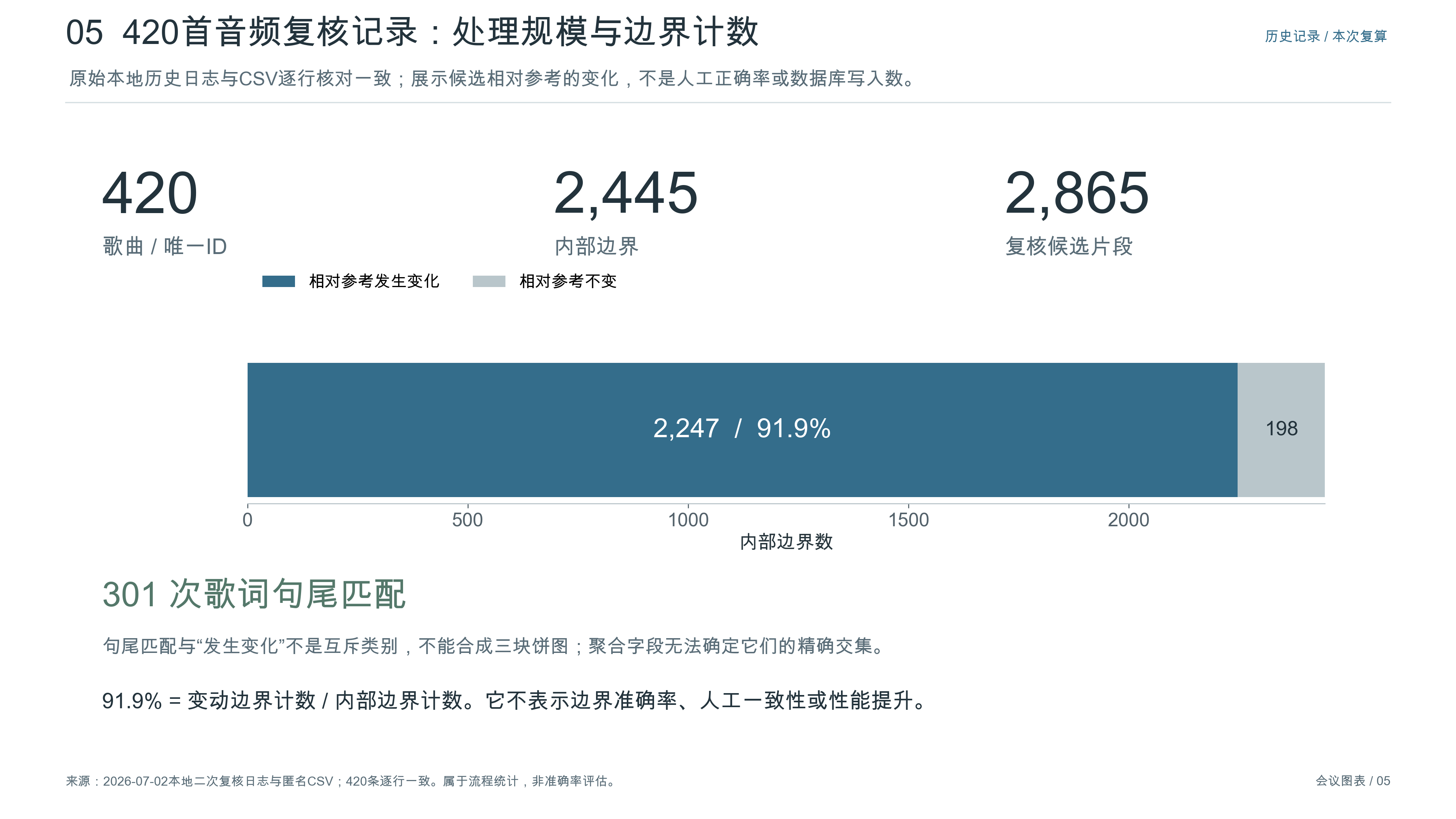
The 91.90% change fraction describes processing activity. It is not boundary accuracy, and no independent human boundary gold standard is established by these counters. Audio and individual annotations remain outside this public release.
Workflow code & aggregate records ↗How boundary review works
I designed the review workflow and interface so an annotator can listen around a candidate transition, move its boundary, and export structured time ranges for further review.
- Start with an AI reference. Check coverage and continuity against the recording timeline.
- Review the transition. Inspect waveform-energy troughs and nearby lyric endings as timing cues, then listen on both sides of the proposed boundary.
- Record the revision. Validate ordered, continuous segments and preserve the processing record for later inspection.
Acoustic examples and error analysis
The related segmentation study plots waveform and novelty over time. A retained competing-peak example illustrates why strong acoustic changes can produce competing boundary candidates and still require human listening.
Semantic annotation and calibration
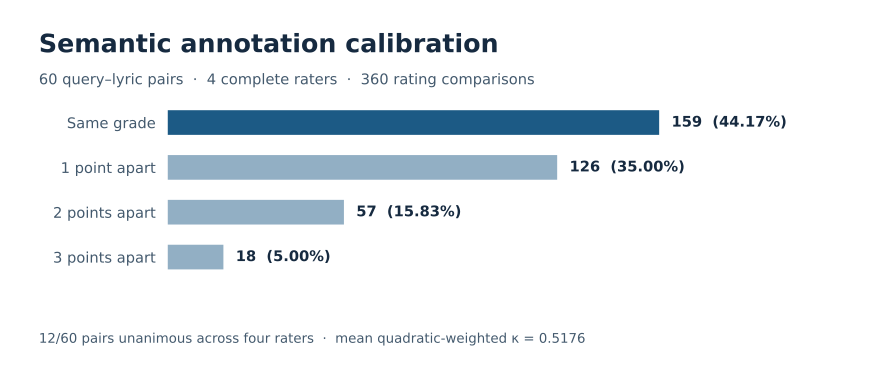
Formal export: 1,818 tasks, 2,854 pairs and 2,760 valid pair ratings; only 80 tasks were fully completed. Calibration used four complete raters on 60 pairs, yielding 360 pairwise comparisons.
| Calibration metric | Recorded result |
|---|---|
| Pooled exact agreement | 44.17% |
| Mean quadratic-weighted kappa | 0.5176 |
| Unanimous items | 12 / 60 |
The agreement calculation uses the 240 ratings from four complete raters. The calibration export contains 242 ratings overall, including two from an incomplete fifth rater. Agreement is not semantic correctness or a completed corpus. No lyrics, individual ratings, annotator identities or task records are published.
Selected annotation evidence ↗From a query–lyric pair to a reviewed label
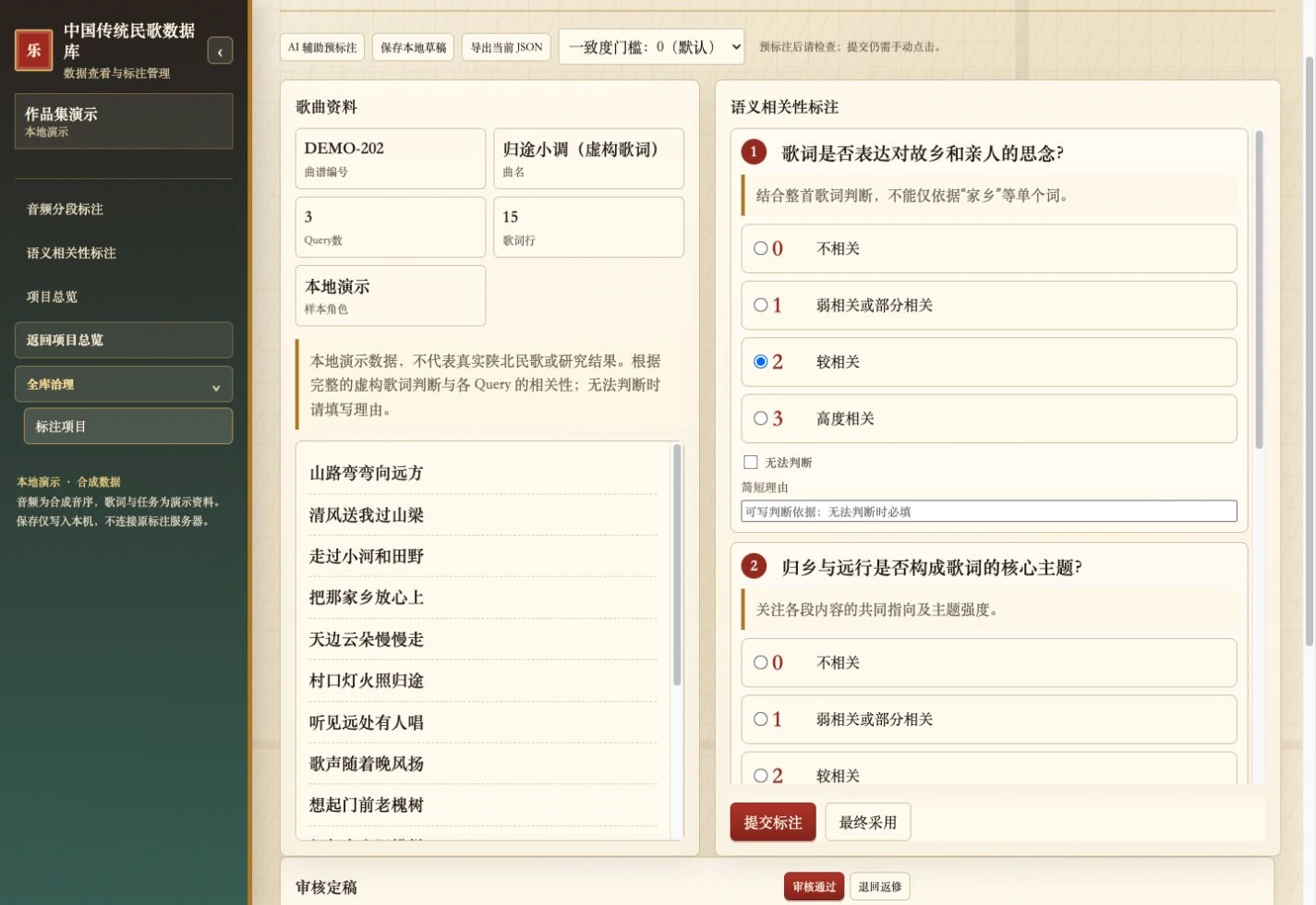
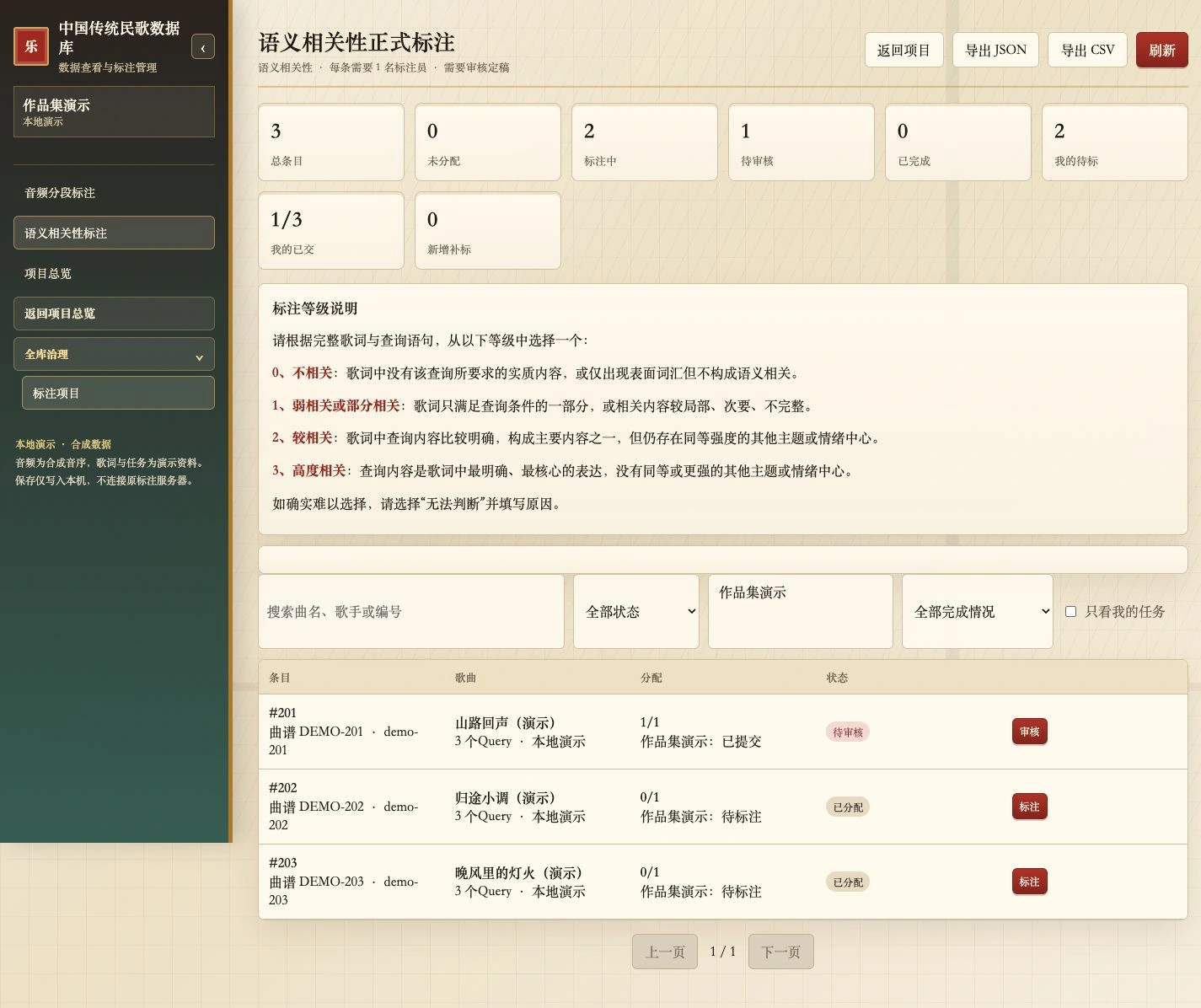
I built the rating and calibration workflow. Raters read the complete lyric against a query and assign one of four relevance levels from 0 (unrelated) to 3 (highly relevant). Uncertain cases can be marked for review with a reason. An LLM can suggest a preliminary rating for human inspection.
How the agreement numbers were calculated
Each of the 60 shared pairs has six pairwise comparisons among four complete raters, giving 360 comparisons. Exact agreement counts identical labels. Quadratic-weighted κ gives larger disagreements on the ordered scale greater weight. The two ratings from the incomplete fifth rater were excluded from these agreement calculations.
The low unanimity count points to items that benefit from adjudication or clearer grading criteria. This study measures rater agreement on the calibration set, separately from the ReCoP lyrics-retrieval experiment.
ReelStudio and related projects
ReelMesh Studio / ShortDramaAgent
Project specifications, assets, storyboards, generation tasks, human approval and editing form a reviewable production workflow. Music and editor execution can involve separate companion skills. The existing public repository is a historical workbench snapshot, not the current internal production system. No company efficiency or formal user-study result is claimed.
ReelStudio workflow and my contribution
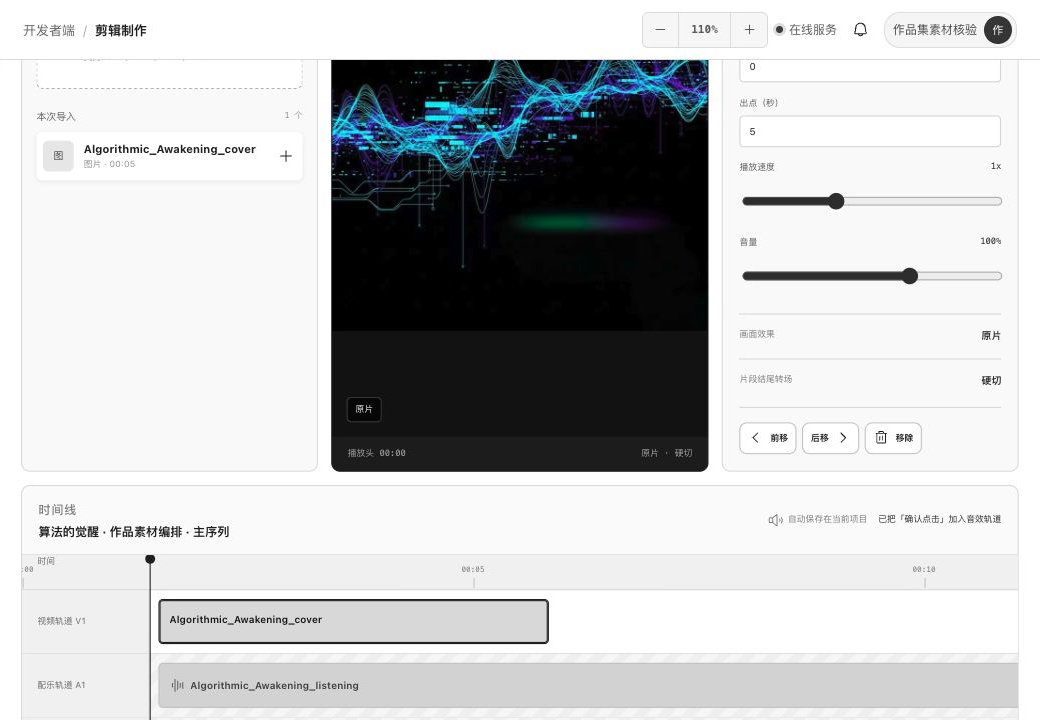
ReelStudio, formerly ReelMesh Studio, connects project requirements and approved references to structured prompts and provider tasks. I built the workbench, prompt and specification workflow, provider adapters, and the asset review and version tracking flow.
- Plan. Turn project requirements and reference assets into a shot specification.
- Generate and review. Queue requests, inspect candidates, retain earlier versions on retry, and approve assets before handing them to editing.
- Edit and deliver. Place approved assets on the audiovisual timeline and prepare subtitles, previews, and project exports.
Controlled engineering checks
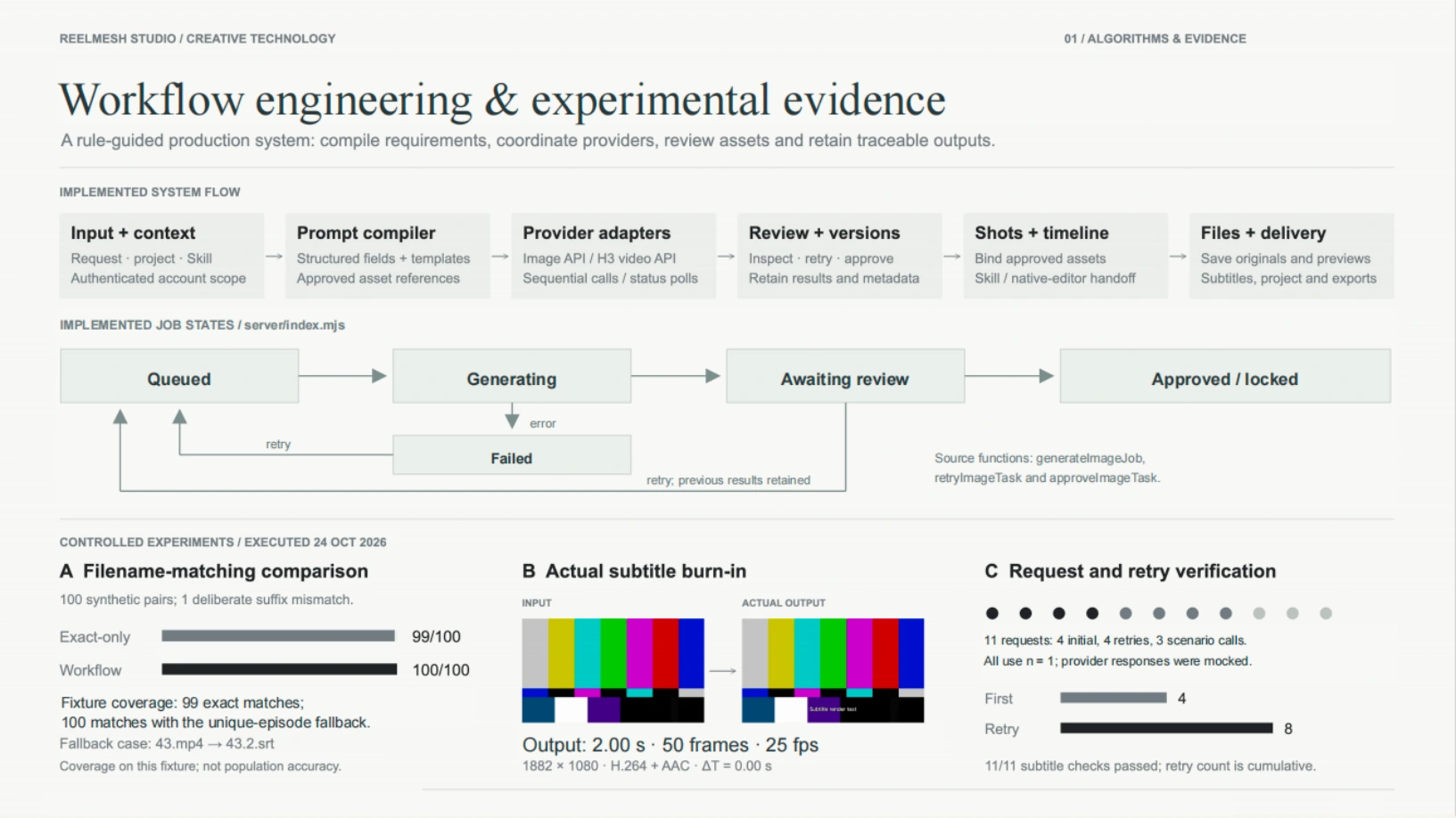
- Filename matching. Exact matching covered 99 of 100 synthetic pairs. A unique-episode fallback covered the deliberate suffix mismatch on that fixture.
- Subtitle burn-in. A rendered test output was 2.00 seconds at 25 fps, with 50 frames.
- Request and retry. The harness recorded 11 requests across initial calls, retries and scenarios. Provider responses were mocked. These checks exercise workflow behaviour under controlled inputs.
ReelStudio project ↗ · Watch the production example, Where the Wild Ends ↗
Xunpu GraphOMR
The existing baseline uses typed symbol graphs and geometric reconstruction. Its 16 cases are two synthetic fixtures under eight image conditions: mean pitch match 96.9%, duration match 94.3%, and 14/16 exact sequences. These correlated regression cases do not establish real-score generalisation.
Baseline & retained failures ↗ Read the full GraphOMR case study ↗Twelve-Tone Matrix
Transparent pitch-class transformations, matrix exploration and MusicXML export support compositional decisions.
Original music and film practice
Listen to Algorithmic Awakening and Vanished Kingdom, inspect scores, and review the documented creative process.
Music, scores and process ↗