Musicology-Guided Structural Attention (MGSA)
Measure-Level Boundary Detection in Symbolic Music
Independent research · Manuscript in preparation · Preliminary validationCan explicit musicological priors improve measure-level boundary detection in symbolic scores?
MUSICOLOGICAL PRIORSMetric + Motif + Harmony + Cadence + Repetition − Boundary
The sum covers Metric, Motif, Harmony, Cadence and Repetition. Nonnegative weights control each bias; Boundary enters as a separate subtractive term.
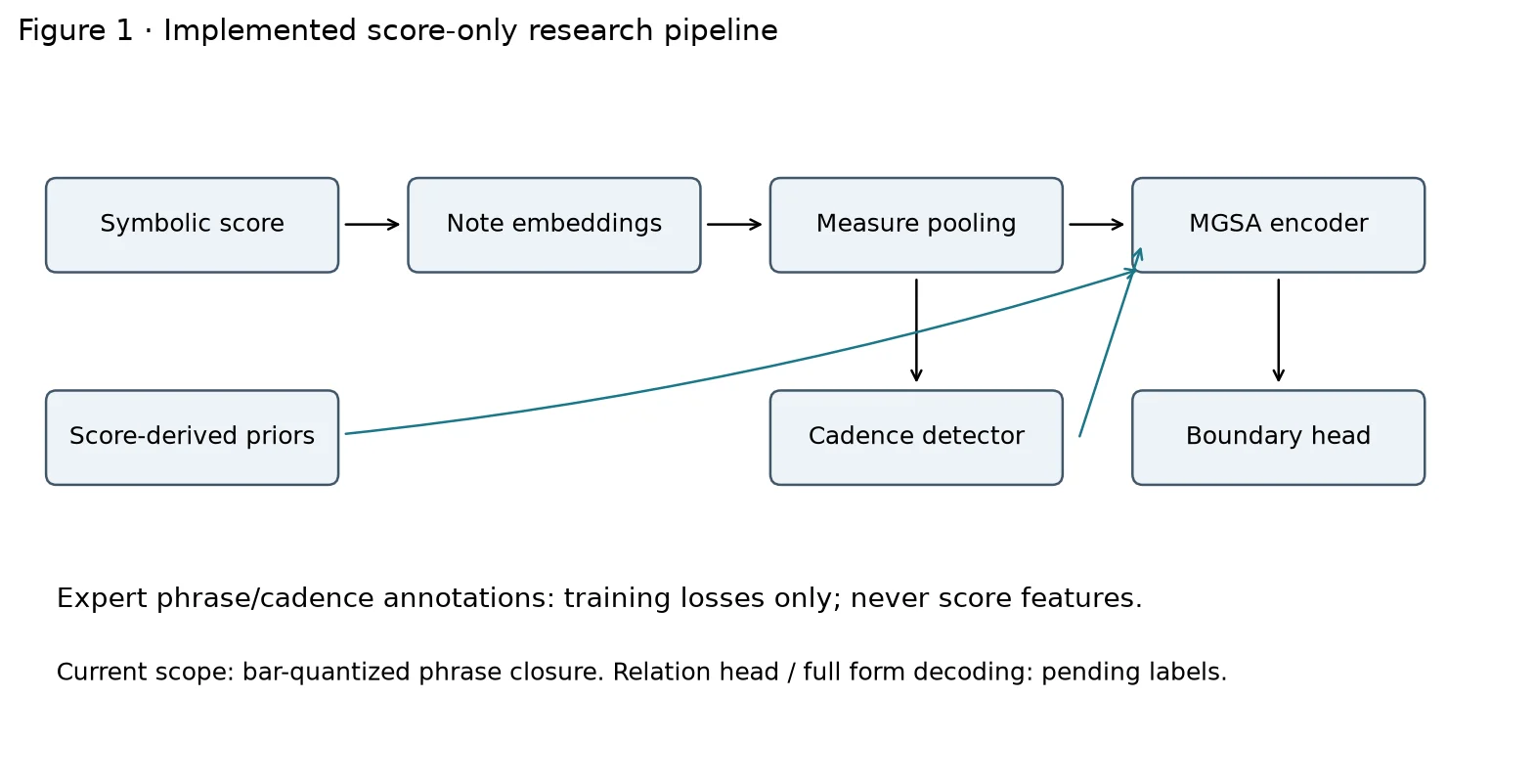 View architecture ↗
Current prototype · Boundary / phrase-ending pilot on Mozart symbolic scores, with baseline and prior-ablation experiments.
Research targets · Independently supervised section relations and global form decoding remain to be completed.
Data & annotation pipeline. The pilot uses sonata-grouped splits from the DCML Mozart piano-sonata corpus, with phrase-boundary projections and cadence supervision from its annotations. Score-derived input features are separated from annotation supervision. Preprocessing records grouped splits, annotation audits, and data fingerprints. These are derived research assets, not a newly authored corpus.
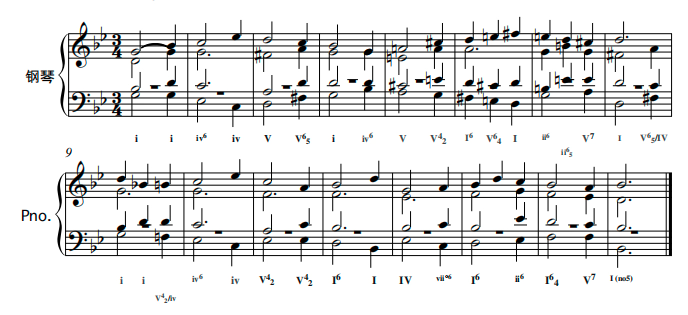
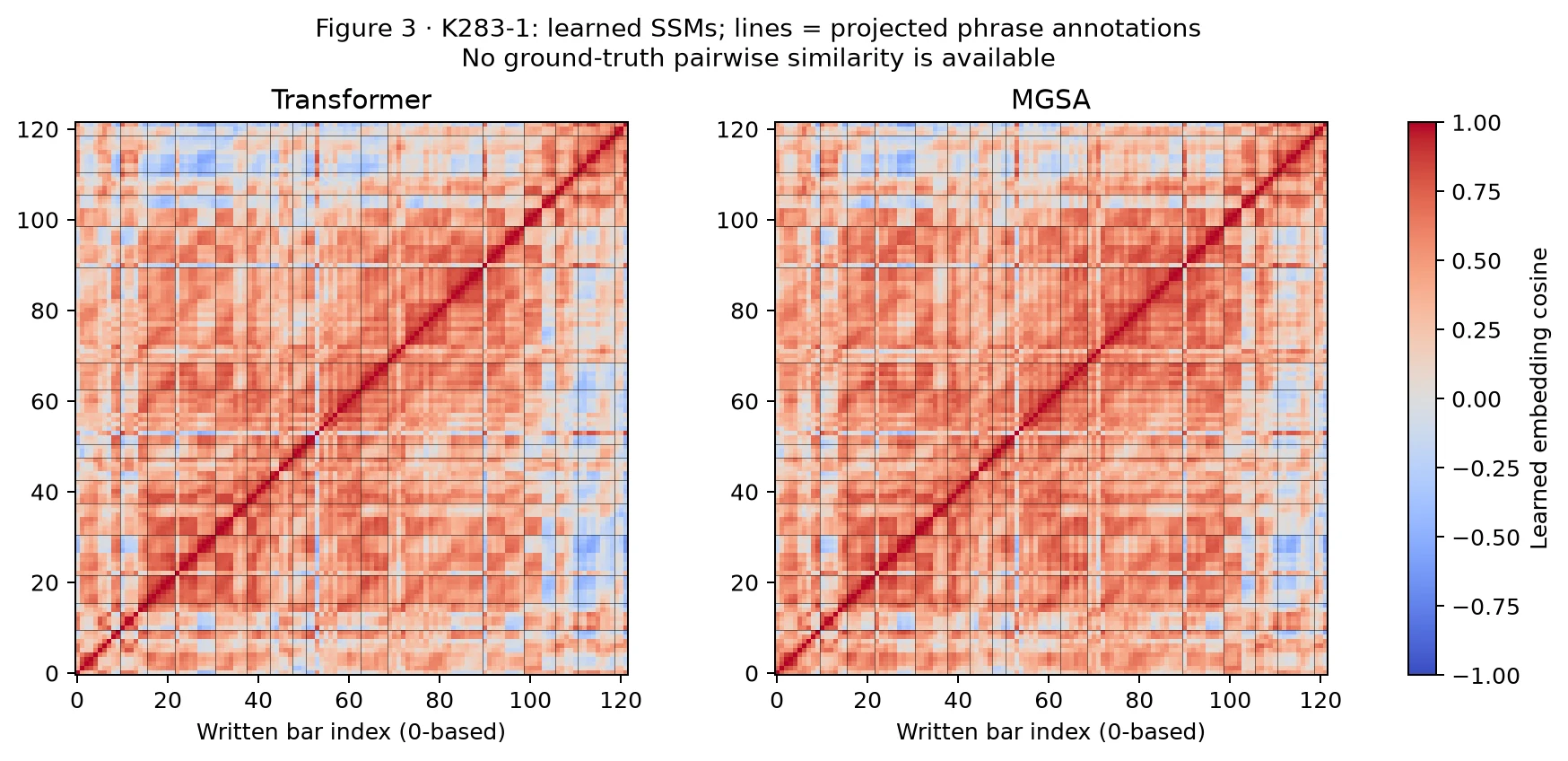
Real-score pilot · Mozart K.283, movement I
Exploratory case study / preliminary visualisations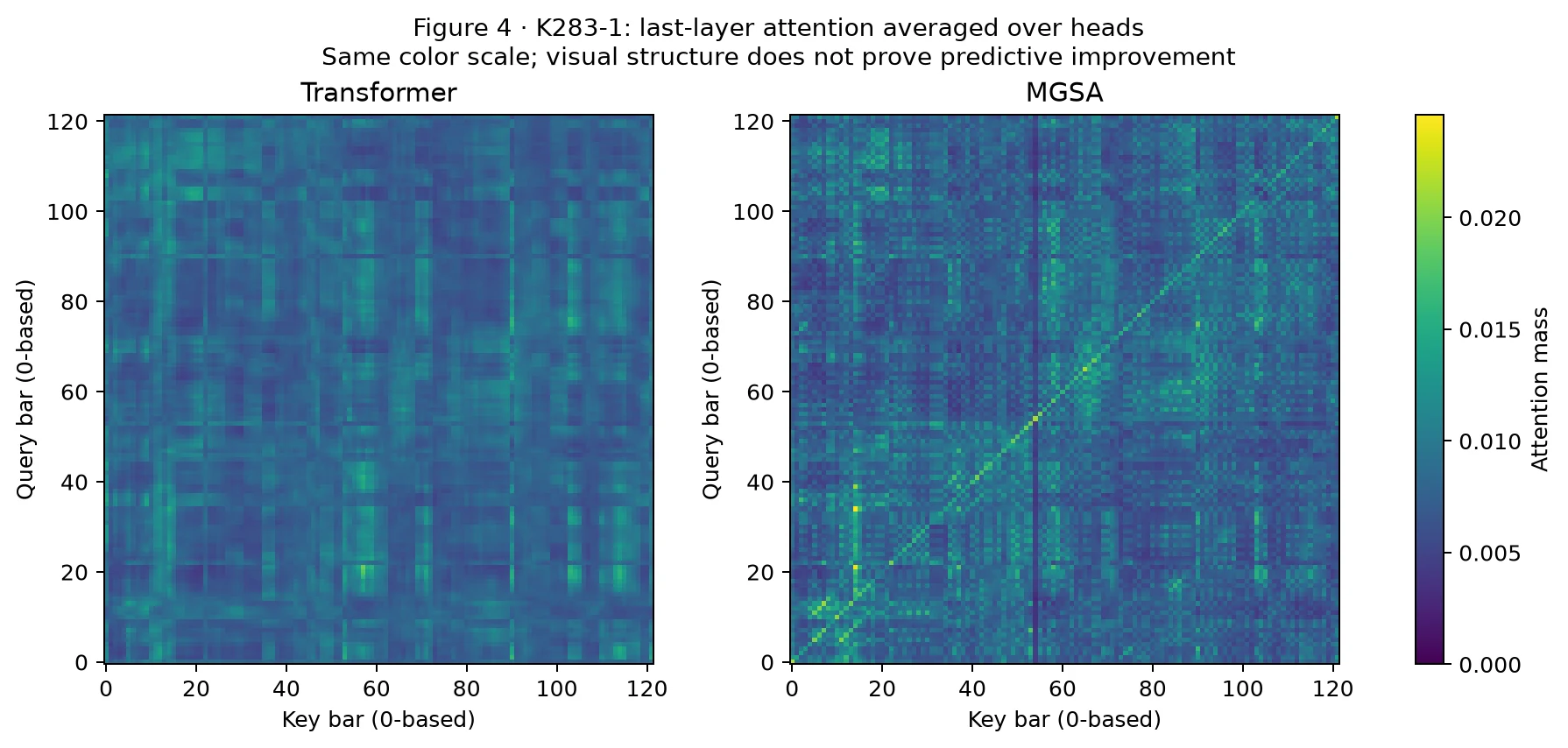
Research method & evaluation
Data. DCML Mozart: 18 sonatas / 54 movements. Fold 0 is grouped by sonata: 10 / 4 / 4 sonatas, or 30 / 12 / 12 movements, for train / validation / test.
Metrics. Test event micro F1 with one-to-one boundary matching: exact gap or ±1 measure. Reference phrase-ending onsets are projected to inter-measure gaps. Checkpoint and threshold are selected on validation. F1 is not per-gap accuracy.
Baseline comparison
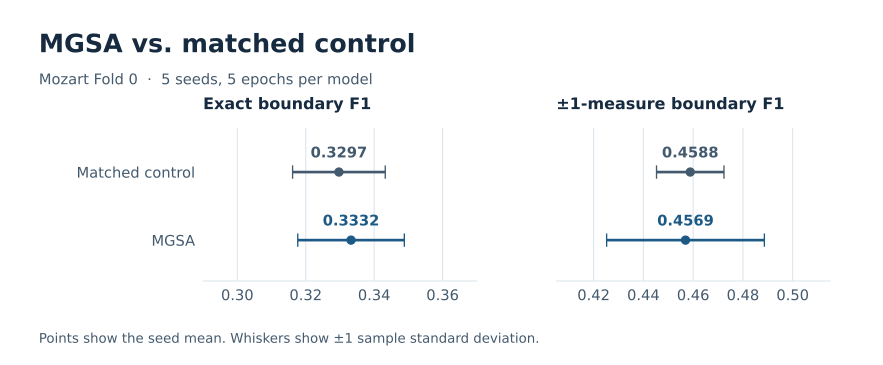
Learned models use five seeds and five epochs. The matched control keeps learned pooling, the encoder, decoder and auxiliary cadence supervision; it disables attention priors.
| Method / configuration | Exact F1 | ±1-measure F1 |
|---|---|---|
| Novelty (single deterministic run) | 0.2639 (single run) | 0.3624 (single run) |
| Mean-pooling Transformer | 0.3133 ± 0.0164 | 0.4324 ± 0.0109 |
| Matched pooling / no priors | 0.3297 ± 0.0135 | 0.4588 ± 0.0136 |
| Full MGSA | 0.3332 ± 0.0156 | 0.4569 ± 0.0317 |
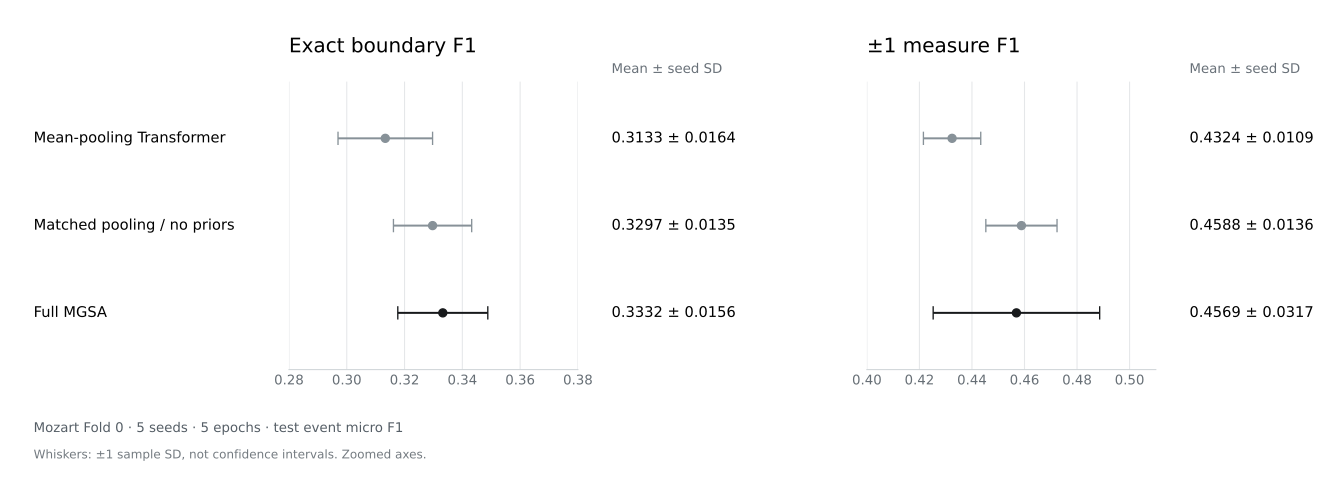
MGSA minus matched control: exact F1 +0.35 percentage points; ±1-measure F1 -0.19 percentage points.
Ablation study
Each leave-one-prior-out variant is retrained with the same fold, seeds, pooling and five-epoch budget. Removing cadence bias does not remove auxiliary cadence supervision.
| Method / configuration | Exact F1 | ±1-measure F1 |
|---|---|---|
| Full MGSA | 0.3332 ± 0.0156 | 0.4569 ± 0.0317 |
| − Metric | 0.3293 ± 0.0053 | 0.4462 ± 0.0254 |
| − Motif | 0.3319 ± 0.0096 | 0.4538 ± 0.0188 |
| − Harmony | 0.3346 ± 0.0085 | 0.4528 ± 0.0199 |
| − Cadence | 0.3353 ± 0.0199 | 0.4477 ± 0.0155 |
| − Repetition | 0.3365 ± 0.0148 | 0.4501 ± 0.0140 |
| − Boundary | 0.3346 ± 0.0111 | 0.4514 ± 0.0214 |
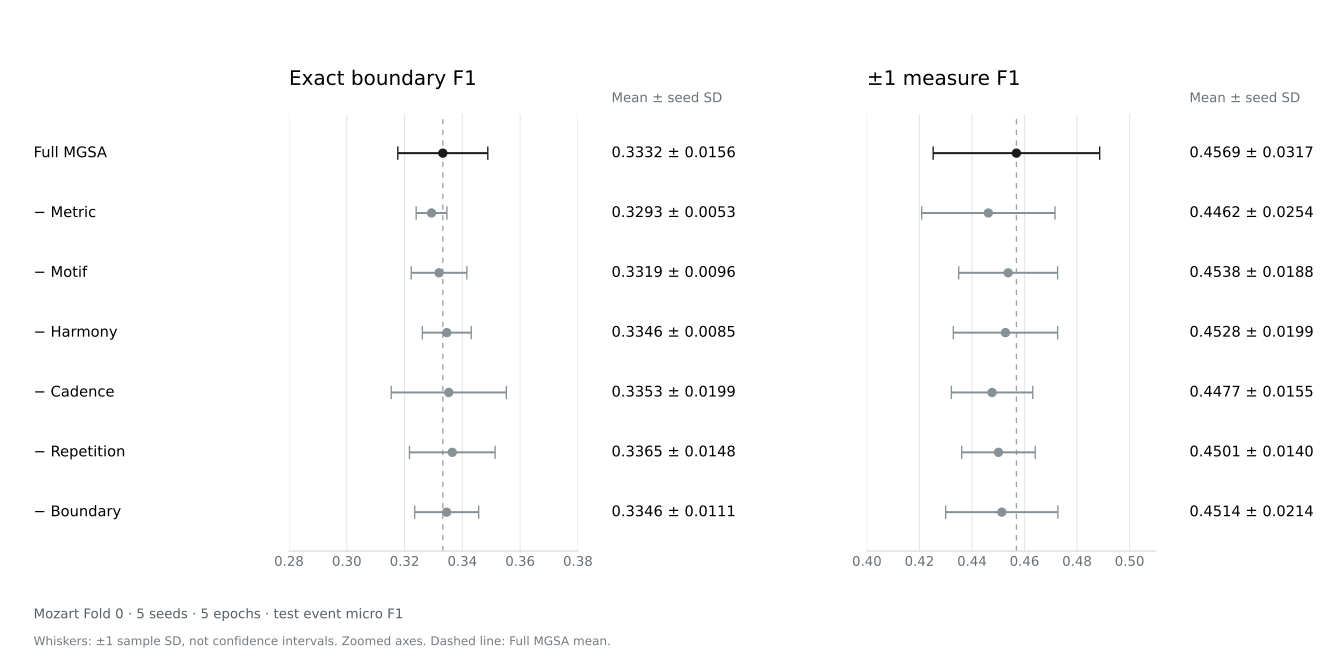
All removals lower mean tolerant F1 in this pilot; exact F1 changes are mixed. These observations do not prove a reliable contribution from every prior.
Multi-seed stability
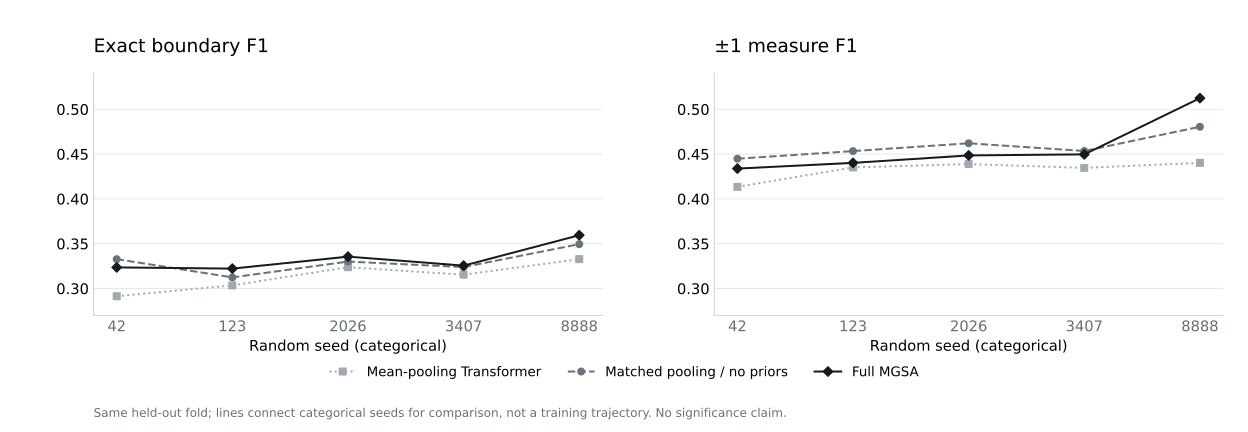
MGSA exceeds matched pooling on exact F1 in 4/5 seeds, but on ±1-measure F1 in only 1/5 seeds. Tolerant seed SD is larger for MGSA (0.0317) than for the control (0.0136).
Held-out example · Mozart K.283, movement I
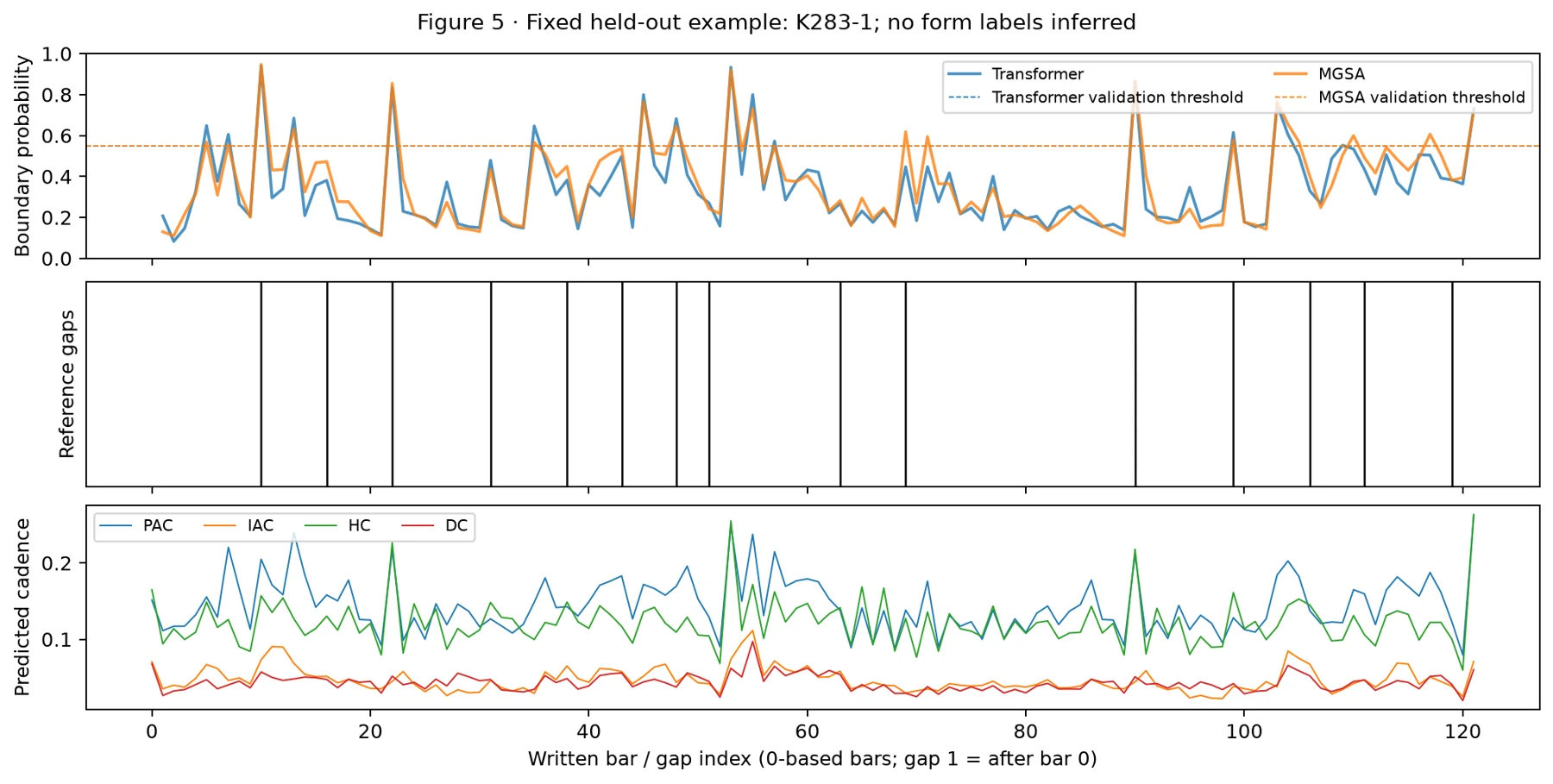
This retained pilot figure shows the Transformer and MGSA gap probabilities, DCML-derived reference positions and the model’s cadence probabilities. Gap indices use the original figure’s zero-based convention.
Per-seed results
| Seed | Mean pooling | Matched pooling | Full MGSA |
|---|---|---|---|
| 42 | 0.2913 | 0.3327 | 0.3235 |
| 123 | 0.3035 | 0.3124 | 0.3222 |
| 2026 | 0.3237 | 0.3300 | 0.3355 |
| 3407 | 0.3154 | 0.3239 | 0.3255 |
| 8888 | 0.3328 | 0.3495 | 0.3595 |
| Seed | Mean pooling | Matched pooling | Full MGSA |
|---|---|---|---|
| 42 | 0.4134 | 0.4448 | 0.4338 |
| 123 | 0.4351 | 0.4533 | 0.4402 |
| 2026 | 0.4388 | 0.4620 | 0.4485 |
| 3407 | 0.4346 | 0.4534 | 0.4497 |
| 8888 | 0.4402 | 0.4805 | 0.5124 |
Current conclusion: no consistent advantage over the matched control has been established. One composer, one fold and short training limit the interpretation. Seed SD is not a cross-work confidence interval; no statistical-significance claim is made. Full form and independent section-relation metrics are unavailable. OMR is evaluated separately.
Next: longer training, additional folds and a frozen comparison protocol.